Saturday, July 08, 2006

ENEMEY of Polygonum chinense

ABALI - the Organic Garden on Vrikshayaurveda

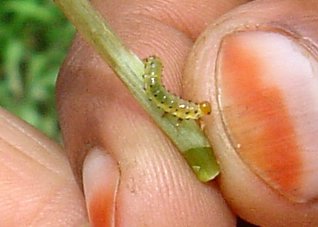
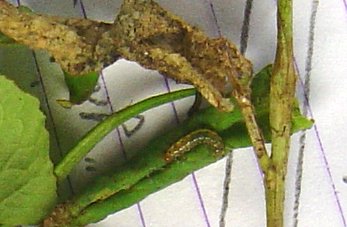
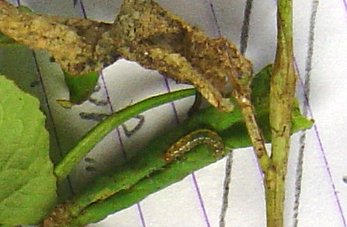
On my visit to Abali last month I was pleasantly surprised seeing a caterpillar feeding only on Polygonum chinense. The rest of the weeds around it were untouched by it. And I found this in a few places. I have brought this caterpillar back and given it to Tea Research Association, Jorhat to identify this caterpillar.
In case anyone has an idea of what this caterpillar is or if they have seen similar ones in their gardens, please get back to me/TRA.
I am attaching a couple of photographs on this blog

Thursday, June 22, 2006

Organic Conference -4th July2006

There is an Organic Tea conference coming up in Dibrugarh, Assam, INDIA on the 4th of July. It is going to be differen to most Organic Tea conferences as it is dealing with Vrikshayurveda. I have visited Abali T.Estate where this is being practiced and have since got involved in this. There are a lot of books on this published by the Asian Agri-History Foundation based in Secundarabad, Andhra, INDIA.
I append a copy of the invitation giving some details about it:-

I N V I T A T I O N


CONFERENCE ON " ORGANIC TEA CULTIVATION " – VRIKSHAYURVEDA : THE ANCIENT SCIENCE OF PLANT LIFE, AT DIBRUGARH

Dear Sir,

You are cordially invited to attend Organic Tea Conference / Workshop on Tuesday 4th July 2006 at Surajmal Jalan Auditorium, Medical College Road, Dibrugarh, Assam.

The Speakers will be:

1. Introduction.
2. Swami Valmiki, Abali, Roing, Arunachal Pradesh.
3. Dr. N. Ghosh Hajra, Tea Board of India, Kurseong, Darjelling. 4. Mr Harkirath Singh Siddhu, Senior Tea Planter.
5. Dr Nandini Shah
6. Dr Anjali Pathak, on Agnihotra farming.

The Program is as follows:

04/07/06 Conference 10:30 AM to 2:30 PM at Jalan Auditorium including tea and lunch.
05/07/06 Visit to Abali Organic Tea Estate in Arunachal Pradesh and overnight stay at Abali / Roing (optional). Visit organized at Organizers cost.
06/07/06 Visit Abali Organic Tea Estate and afternoon return back to Dibrugarh (optional).

You are welcome to visit Abali Organic Tea Estate in Arunachal Pradesh on 5th and 6th July, please let us know in advance so that we can make arrangements.

For further enquiry please contact us.

Thanking you,


(Binod Saharia)
Abali Tea Estate
Chottagola
A.T.Road, Dibrugarh 786001 Assam

Phone: (M) 09435031097 (O) 0373-2302930 2300495
Email: http://f2mail.rediff.com/bn/compose.cgi?login=teatechoutsourcing&session_id=2K1KCK1mf8UO3BooUEL4s4MnEFVU&FormName=mail_to_individual&email=binod57@yahoo.com

Thursday, June 01, 2006

Looper caterpillar attack - what to do now

1st June 2006
Looper Caterpillar - Buzura(Biston)suppressaria Guen

I have had requests from certain gardens for advise on what action estates need to take now to prevent the next brood from causing massive damage to their plantations. They apparently had a very severe attack of looper a month or two ago that caused massive damage.
Suggestion:
From the 1st week July keep a regular vigil on fresh occurrence in areas where this attack had occurred. When the eggs hatch and the caterpillars are young it is the best time to hit them. How do you know when this is about to happen ? As soon as you start seeing moths coming to lights, remember they have just finished laying their eggs and so the hatching will take place within a fortnight. So keep a very close watch in those areas; within 20 days from when you see the moths you will start noticing the small holes along margins of young leaves. As soon as you notice 15% of the bushes with some of this damage, it is time to thoroughly spray that full patch.
Spray any recommended insecticide but ensure that the spray penetrates deep into the canopy and also gets onto the low hanging side branches. I, however, prefer using neem formulations as soon as 5% (instead of 15%) damage is noticed as this works well against the juvenile caterpillars. If however you get a little late in spotting it then use Bacillus thuringiensis as this works brilliantly. If by the time you spot it the caterpillars are fully matured you may use a synthetic parathyroid for 1 round.

In mid-August again repeat the same vigil as the next brood will be ready to attack.
Points to note:
a) Light traps / Pest-o-Flash’ are no good for control but good for monitoring population: pairing of moths takes place on the day of emergence. And the laying of eggs starts from the very next day. So by the time they come to the trap they have already laid their eggs.
b) Collection of chrysalides- between March & April or between October & December. The pupa is brown /dark brown with serrated ridges 1 on each side and is aprox 2 to 2.5 cm long. It can be collected by light forking around the collar region of the affected bushes ( 2.5 to 5 cms deep in the soil)
c) If the attack has been severe and a lot of defoliation has taken place, it is a must to add back the lost Maintenance Foliage.

Saturday, August 27, 2005

Mechenical Harvesting ? Where are we ?!

I am pasting an excerpt from an article of mine on the Serious Problems the Indian Tea Industry is facing. I would like you to discuss and give your comments on whether we should go in for Mechanical aids for Harvesting and where we went wrong in North India. Let us have your views, whatever they be, and learn from them.

" 2. We need to look at Mechanization as a tool that we have to make work. A very clear example is that of mechanical harvesting ….
Mechanization of harvesting: This was tried out some years ago in the North East and in most cases the verdict was very clear that it affected quality adversely. As a result mechanical harvesting was thrown out.
I would like to go back in time... something similar took place in 1970/71. There were these new Withering Troughs which were being tried out to replace the old labour intensive ‘changs’ (the old leaf houses). After 6 months trials the verdict was similar - the old system produced better quality. BUT unlike with Mechanical harvesting, the system was not thrown out: it was worked at and modified & modified to suit the industry’s requirement. It was clear that for the future the labour intensive operation (which also would have been capital intensive for increasing capacity) needed to be changed to stay competitive. As a result this system of ‘trough withering’ is the only form of withering today.
But with Mechanical Harvesting somewhere down the line we lost our way. Just imagine if we had done the same thing with Trough Withering.
However, some other growing countries have persisted with it and have results to show today."

Saturday, May 14, 2005

Te@ Technologies Outsourcing

Outsourcing Services to the Tea Industry:

Bringing practical and affordable solutions to your business problems.
Te@ Technologies Outsourcing (TTOS) was set up in response to client demand for practical business solutions. The founder, previously the Director of Rossell Industries Ltd and Head of Unilever Plantations in North East India, has established this organisation to bring real world solutions to the tea industry and enable organizations to upgrade the knowledge, skills and efficiency of their management teams.

Scope of the services:
1. We offer unparalleled expertise in identifying & evaluating problems and then delivering solutions. You just call upon us and we will work with you to help identify the problem and then find the solution.
2. We evaluate a Plantation Company's operations / policies / management and then recommend a comprehensive Business Plan. Complete package of practices (innovative and the best) in Field, Factory, Admin, Cost cutting, Product mix, Marketing, etc for improving profitability. We give an outside-in perspective on issues or opportunity facing the business or organisation or existing in the marketplace.
3. We specialize in Training of Executives & supervisory staff on all aspects of plantation operations, including HR for Plantations. We bring in views and practices from across the tea world to help your teams get a broader picture, wider knowledge and ‘experience’ and the required skill to take the business forward.
4. Advisory service – This is not a run-of-the-mill “consultancy service”: we do things differently. We bring international experience to understand your issues and re-look at your operations. We can make a real difference to your organisation with our insight and wide experience. We offer opportunities that we might identify for you. Our focus is on practical solutions: solutions backed by wide international ‘real world’ experience, clarity of vision, supported by research & business school theory. ……………………………………………………………………...

Because TTOS works exclusively in the field of outsourcing services, it updates its knowledge base continuously and maintains its leading edge in the field. Market developments are constantly monitored… it can provide advice on emerging opportunities, strategies and technologies that affect the various operations, markets,… and finally, it helps clients move their businesses forward.
In a demanding market – with increasing pressures to perform and ever-increasing expectations, TTOS can apply that vital, impartial sense check and a flexible incremental resource to address important strategic and organisational opportunities that could otherwise get sidelined.
TTOS provides qualified and flexible resource to apply to operational, organisational and strategic opportunities
In whatever sector of the tea market you operate TTOS has expertise (or access to outsource experts best in the required field) that can make a difference to your organisation.

Harki Sidhu

Harkirat Singh Sidhu
Te@ Technologies Outsourcing
Flat # 2 B, Golf Towers
9, Prince Goolam Md. Shah Road
Calcutta 700 095
Tel # 91-33-24223007 9830550975
E-mail: teatechos@gmail.com
: harkisidhu@hotmail.com